This year’s edition of the London International Innovation Fair ITE (International Invention and Trade Expo) 2026 just ended in London, bringing together exhibitors from 29 countries worldwide who presented more than 350 exhibits.
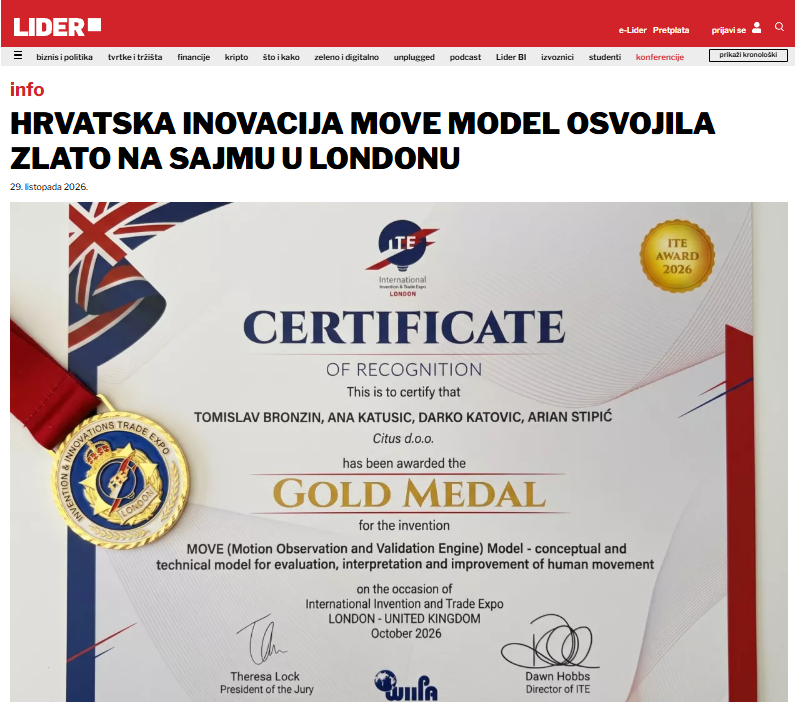
In this prestigious competition, our innovation, “MOVE (Motion Observation and Validation Engine) Model – Conceptual and Technical Model for Evaluation, Interpretation and Enhancement of Human Movement,” won the gold medal.
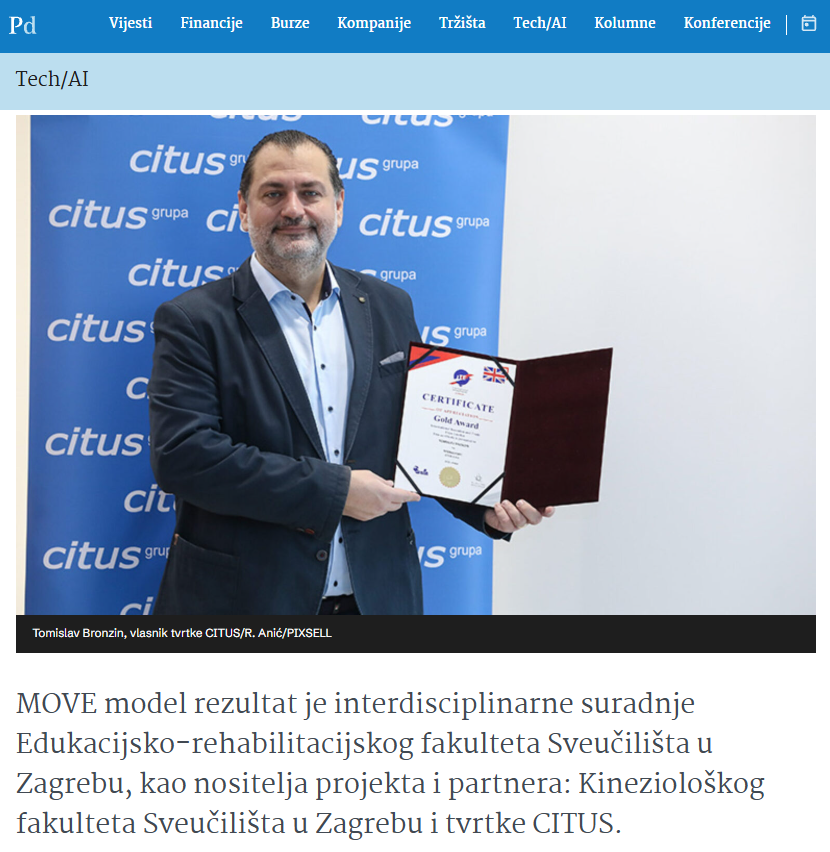
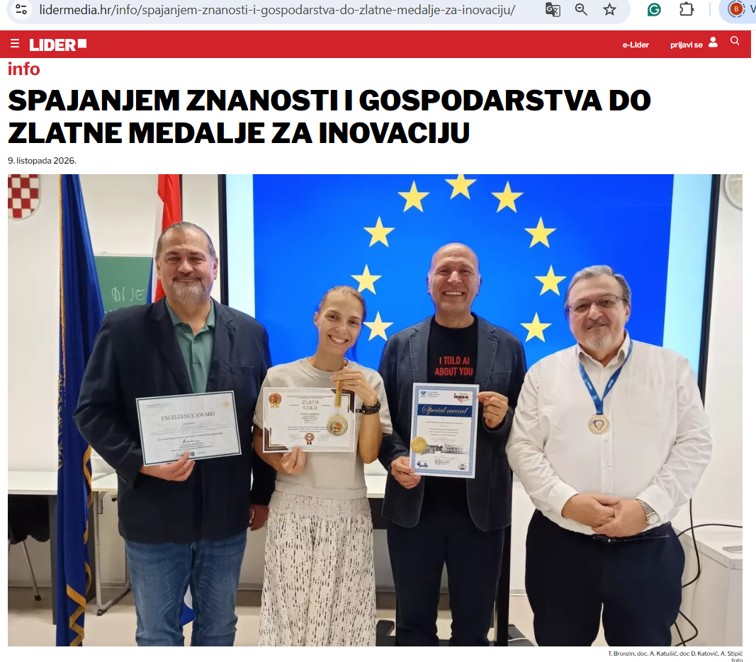
This solution is the result of the work of an interdisciplinary consortium led by the Faculty of Education and Rehabilitation Sciences of the University of Zagreb, with partners the Faculty of Kinesiology of the University of Zagreb and the company CITUS, who are collaborating on a collaborative scientific research project (CSR) entitled “Modeling and analysis of personalized and optimal movement patterns in rehabilitation, sports and fitness using artificial intelligence (AI)”.
The MOVE Framework is an innovative conceptual and technical model for formally representing, evaluating, and interpreting human movement. The model defines a multi-level hierarchy composed of the entities Model, Phase, and Pose, with each level containing its own sets of detection rules, boundary conditions, indicators, interpretations, improvement recommendations, and evaluation outcomes.
The framework utilizes a standardized representation of the human body based on anatomical landmarks, connecting segments, absolute and relative joint angles, and kinematic chains of varying complexity. Based on these elements, the framework defines multidimensional indicators, each associated with acceptable, optimal, and reference value ranges, enabling objective and personalized assessment of movement performance. A key innovation of the model is its integrated system of Interpretation Rules and Improvement Rules, which enables semantic interpretation of deviations between the observed movement and the reference movement model. Rather than merely detecting errors, the system determines the meaning of deviations, generates explanations, and proposes corrective or optimization actions aimed at improving performance. This approach enables the development of intelligent systems that can understand, evaluate, and continuously enhance human movement across a wide range of domains, including sports, rehabilitation, healthcare, physical fitness assessment, and human performance optimization.
The collaborative scientific research (CSR) project titled “Modeling and Analysis of Personalized and Optimal Movement Patterns in Rehabilitation, Sport, and Fitness Using Artificial Intelligence (AI)” has been co-financed through the Collaborative Scientific Research Grants Program, underscoring the importance of investing in research and development (R&D) as a driver of sustainable economic growth.
Additional information:
PRESS RELEASE